
Publications
Filter by tags expand
Click a tag to show matching publications.
 Paper A deep residual convolutional neural network for automatic lithological facies identification in Brazilian pre-salt oilfield wellbore image logs Journal of Petroleum Science and Engineering A deep residual convolutional neural network for automatic lithological facies identification in Brazilian pre-salt oilfield wellbore image logs. NN Imaging Geo JPSE Publication details Paper
A deep residual convolutional neural network for automatic lithological facies identification in Brazilian pre-salt oilfield wellbore image logs.
 Paper Estimation of permeability and effective porosity logs using deep autoencoders in borehole image logs from the Brazilian pre-salt carbonate Journal of Petroleum Science and Engineering Estimation of permeability and effective porosity logs using deep autoencoders in borehole image logs from the Brazilian pre-salt carbonate. Imaging Geo JPSE Publication details Paper
Estimation of permeability and effective porosity logs using deep autoencoders in borehole image logs from the Brazilian pre-salt carbonate.
 Paper Bayesian deep networks for absolute permeability and porosity uncertainty prediction from image borehole logs from Brazilian carbonate reservoirs Journal of Petroleum Science and Engineering Bayesian deep networks for absolute permeability and porosity uncertainty prediction from image borehole logs from Brazilian carbonate reservoirs. Imaging Geo JPSE Publication details Paper
Bayesian deep networks for absolute permeability and porosity uncertainty prediction from image borehole logs from Brazilian carbonate reservoirs.
 Paper In-pixel AI for lossy data compression at source for X-ray detectors Nuclear Instruments and Methods in Physics Research Section A: Accelerators, Spectrometers, Detectors and Associated Equipment In-pixel AI for lossy data compression at source for X-ray detectors. Pixel Detectors NIMA Publication details Paper
In-pixel AI for lossy data compression at source for X-ray detectors.
 Paper On a method for Rock Classification using Textural Features and Genetic Optimization Notas Técnicas CBPF-NT-002/10 Abril 2017 On a method for Rock Classification using Textural Features and Genetic Optimization. CBPF Publication details Paper
On a method for Rock Classification using Textural Features and Genetic Optimization.
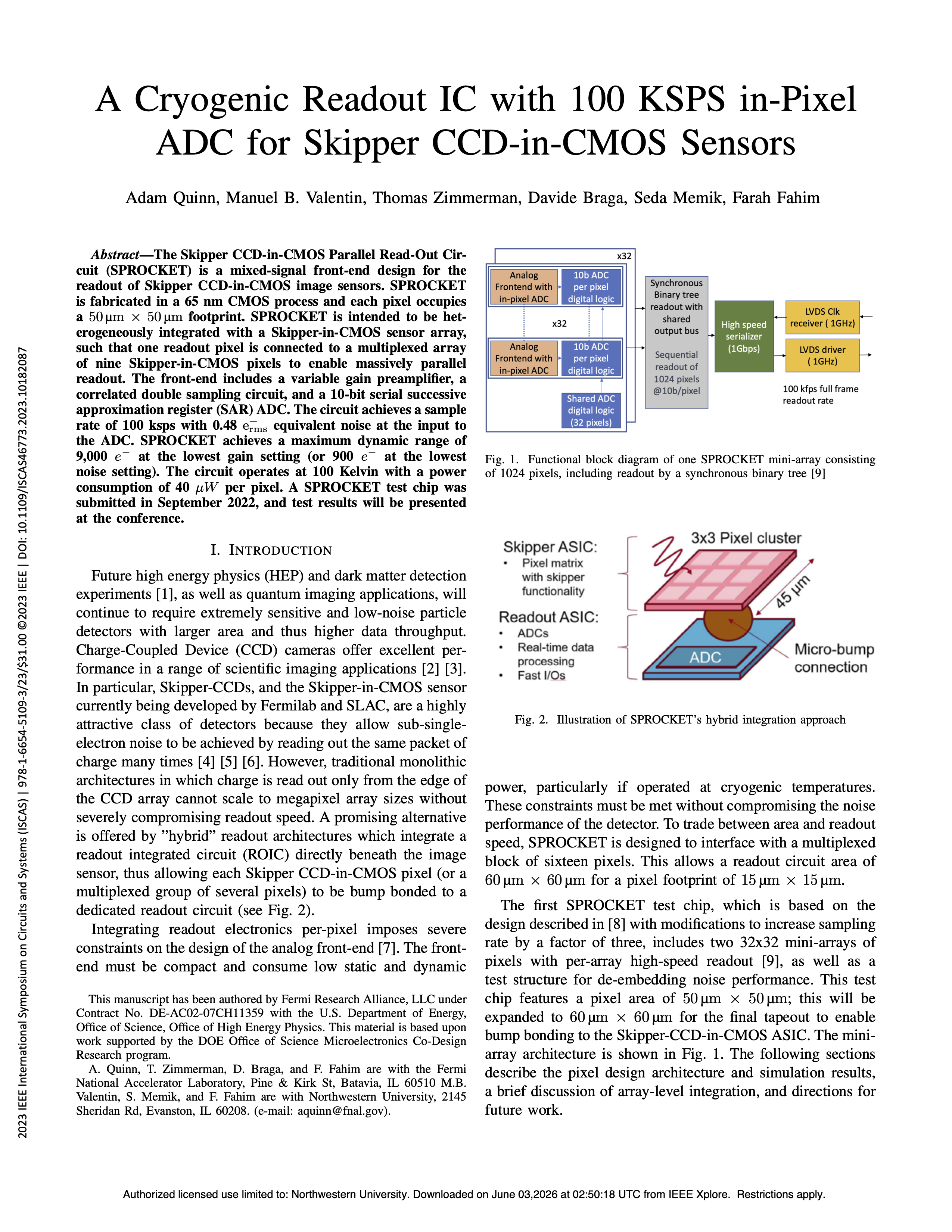 Paper A cryogenic readout ic with 100 ksps in-pixel adc for skipper ccd-in-cmos sensors 2023 IEEE International Symposium on Circuits and Systems (ISCAS) A cryogenic readout ic with 100 ksps in-pixel adc for skipper ccd-in-cmos sensors. Sensors Pixel Cryo ISCAS Publication details Paper
A cryogenic readout ic with 100 ksps in-pixel adc for skipper ccd-in-cmos sensors.
 Paper Texture classification based on spectral analysis and haralick features Notas Técnicas Texture classification based on spectral analysis and haralick features. CBPF Publication details Paper
Texture classification based on spectral analysis and haralick features.
 Paper Rock Texture Classification Using Spectral Analysis And Genetically Optimized Texture Features Computer Vision and Pattern Recognition (CVPR) Rock Texture Classification Using Spectral Analysis And Genetically Optimized Texture Features. CV CVPR Publication details Paper
Rock Texture Classification Using Spectral Analysis And Genetically Optimized Texture Features.
 Paper Toward Reconfigurable In-Pixel Computing: A Fault-Tolerant Design Flow for Machine Learning Accelerators 2025 IEEE 33rd Annual International Symposium on Field-Programmable Custom Computing Machines (FCCM) Toward Reconfigurable In-Pixel Computing: A Fault-Tolerant Design Flow for Machine Learning Accelerators. Reconf. Pixel ML FCCM Publication details Paper
Toward Reconfigurable In-Pixel Computing: A Fault-Tolerant Design Flow for Machine Learning Accelerators.
![A Cryogenic Readout IC with 100 KSPS in-Pixel ADC for Skipper CCD-in-CMOS Sensors [Poster].](https://www.blancovalentin.me/images/publications/sprocket_poster.pdf) POSTER A Cryogenic Readout IC with 100 KSPS in-Pixel ADC for Skipper CCD-in-CMOS Sensors [Poster] Fermi National Accelerator Laboratory (FNAL), Batavia, IL (United States) A Cryogenic Readout IC with 100 KSPS in-Pixel ADC for Skipper CCD-in-CMOS Sensors [Poster]. Quantum Cryo Imaging Sensors Pixel Cryo Readout FNAL Publication details Poster
POSTER A Cryogenic Readout IC with 100 KSPS in-Pixel ADC for Skipper CCD-in-CMOS Sensors [Poster] Fermi National Accelerator Laboratory (FNAL), Batavia, IL (United States) A Cryogenic Readout IC with 100 KSPS in-Pixel ADC for Skipper CCD-in-CMOS Sensors [Poster]. Quantum Cryo Imaging Sensors Pixel Cryo Readout FNAL Publication details Poster
A Cryogenic Readout IC with 100 KSPS in-Pixel ADC for Skipper CCD-in-CMOS Sensors [Poster].
 Thesis Desarrollo del sistema electrónico de control de navegación de un barco remolcador a escala Universitat Politècnica de Catalunya. Escola Universitària d'Enginyeria … Desarrollo del sistema electrónico de control de navegación de un barco remolcador a escala. UPCommons Publication details Thesis
Desarrollo del sistema electrónico de control de navegación de un barco remolcador a escala.
 Preprint hls4ml: An open-source codesign workflow to empower scientific low-power machine learning devices arXiv preprint arXiv:2103.05579 Accessible machine learning algorithms, software, and diagnostic tools for energy-efficient devices and systems are extremely valuable across a broad range of application domains. In scientific domains, real-time near-sensor processing can drastically improve experimental design… HLS ML arXiv Publication details Preprint
Accessible machine learning algorithms, software, and diagnostic tools for energy-efficient devices and systems are extremely valuable across a broad range of application domains. In scientific domains, real-time near-sensor processing can drastically improve experimental design and accelerate scientific discoveries. To support domain scientists, we have developed hls4ml, an open-source software-hardware codesign workflow to interpret and translate machine learning algorithms for implementation with both FPGA and ASIC technologies. We expand on previous hls4ml work by extending capabilities and techniques towards low-power implementations and increased usability: new Python APIs, quantization-aware pruning, end-to-end FPGA workflows, long pipeline kernels for low power, and new device backends include an ASIC workflow. Taken together, these and continued efforts in hls4ml will arm a new generation of domain scientists with accessible, efficient, and powerful tools for machine-learning-accelerated discovery.
 Paper The strong gravitational lens finding challenge Astronomy & Astrophysics Large-scale imaging surveys will increase the number of galaxy-scale strong lensing candidates by maybe three orders of magnitudes beyond the number known today. Finding these rare objects will require picking them out of at least tens of millions of images, and deriving scienti… Astro NN ML A&A Publication details Paper
Large-scale imaging surveys will increase the number of galaxy-scale strong lensing candidates by maybe three orders of magnitudes beyond the number known today. Finding these rare objects will require picking them out of at least tens of millions of images, and deriving scientific results from them will require quantifying the efficiency and bias of any search method. To achieve these objectives automated methods must be developed. Because gravitational lenses are rare objects, reducing false positives will be particularly important. We present a description and results of an open gravitational lens finding challenge. Participants were asked to classify 100 000 candidate objects as to whether they were gravitational lenses or not with the goal of developing better automated methods for finding lenses in large data sets. A variety of methods were used including visual inspection, arc and ring finders, support vector machines (SVM) and convolutional neural networks (CNN). We find that many of the methods will be easily fast enough to analyse the anticipated data flow. In test data, several methods are able to identify upwards of half the lenses after applying some thresholds on the lens characteristics such as lensed image brightness, size or contrast with the lens galaxy without making a single false-positive identification. This is significantly better than direct inspection by humans was able to do. Having multi-band, ground based data is found to be better for this purpose than single-band space based data with lower noise and higher resolution, suggesting that multi-colour data is crucial. Multi-band space based data will be superior to ground based data. The most difficult challenge for a lens finder is differentiating between rare, irregular and ring-like face-on galaxies and true gravitational lenses. The degree to which the efficiency and biases of lens finders can be quantified largely depends on the realism of the simulated data on which the finders are trained.
 Paper Automatic detection of fractures and breakouts patterns in acoustic borehole image logs using fast-region convolutional neural networks Journal of Petroleum Science and Engineering Automatic detection of fractures and breakouts patterns in acoustic borehole image logs using fast-region convolutional neural networks. NN Imaging Geo Petro JPSE Publication details Paper
Automatic detection of fractures and breakouts patterns in acoustic borehole image logs using fast-region convolutional neural networks.
 Paper A reconfigurable neural network ASIC for detector front-end data compression at the HL-LHC IEEE Transactions on Nuclear Science A reconfigurable neural network ASIC for detector front-end data compression at the HL-LHC. Reconf. ASIC HW Detectors NN TNS Publication details Paper
A reconfigurable neural network ASIC for detector front-end data compression at the HL-LHC.
 Paper Developing a victorious strategy to the second strong gravitational lensing data challenge Monthly Notices of the Royal Astronomical Society ABSTRACT Strong lensing is a powerful probe of the matter distribution in galaxies and clusters and a relevant tool for cosmography. Analyses of strong gravitational lenses with deep learning have become a popular approach due to these astronomical objects’ rarity… Astro MNRAS Publication details Paper
ABSTRACT Strong lensing is a powerful probe of the matter distribution in galaxies and clusters and a relevant tool for cosmography. Analyses of strong gravitational lenses with deep learning have become a popular approach due to these astronomical objects’ rarity and image complexity. Next-generation surveys will provide more opportunities to derive science from these objects and an increasing data volume to be analysed. However, finding strong lenses is challenging, as their number densities are orders of magnitude below those of galaxies. Therefore, specific strong lensing search algorithms are required to discover the highest number of systems possible with high purity and low false alarm rate. The need for better algorithms has prompted the development of an open community data science competition named strong gravitational lensing challenge (SGLC). This work presents the deep learning strategies and methodology used to design the highest scoring algorithm in the second SGLC (II SGLC). We discuss the approach used for this data set, the choice of a suitable architecture, particularly the use of a network with two branches to work with images in different resolutions, and its optimization. We also discuss the detectability limit, the lessons learned, and prospects for defining a tailor-made architecture in a survey in contrast to a general one. Finally, we release the models and discuss the best choice to easily adapt the model to a data set representing a survey with a different instrument. This work helps to take a step towards efficient, adaptable, and accurate analyses of strong lenses with deep learning frameworks.
 Preprint Deep learning in wide-field surveys: Fast analysis of strong lenses in ground-based cosmic experiments arXiv preprint arXiv:1911.06341 Searches and analyses of strong gravitational lenses are challenging due to the rarity and image complexity of these astronomical objects. Next-generation surveys (both ground- and space-based) will provide more opportunities to derive science from these objects, but only if the… DL arXiv Publication details Preprint
Searches and analyses of strong gravitational lenses are challenging due to the rarity and image complexity of these astronomical objects. Next-generation surveys (both ground- and space-based) will provide more opportunities to derive science from these objects, but only if they can be analyzed on realistic time-scales. Currently, these analyses are expensive. In this work, we present a regression analysis with uncertainty estimates using deep learning models to measure four parameters of strong gravitational lenses in simulated Dark Energy Survey data. Using only $gri$-band images, we predict Einstein Radius, lens velocity dispersion, lens redshift to within $10-15%$ of truth values and source redshift to $30%$ of truth values, along with predictive uncertainties. This work helps to take a step along the path of faster analyses of strong lenses with deep learning frameworks.
 Paper hls4ml: A flexible, open-source platform for deep learning acceleration on reconfigurable hardware ACM Transactions on Reconfigurable Technology and Systems We present hls4ml , a free and open-source platform that translates machine learning (ML) models from modern deep learning frameworks into high-level synthesis (HLS) code that can be integrated into full designs for field-programmable gate… HLS Reconf. HW DL TRETS Publication details Paper
We present hls4ml , a free and open-source platform that translates machine learning (ML) models from modern deep learning frameworks into high-level synthesis (HLS) code that can be integrated into full designs for field-programmable gate arrays (FPGAs) or application-specific integrated circuits (ASICs). With its flexible and modular design, hls4ml supports a large number of deep learning frameworks and can target HLS compilers from several vendors, including Vitis HLS, Intel oneAPI and Catapult HLS. Together with a wider eco-system for software-hardware co-design, hls4ml has enabled the acceleration of ML inference in a wide range of commercial and scientific applications where low latency, resource usage, and power consumption are critical. In this paper, we describe the structure and functionality of the hls4ml platform. The overarching design considerations for the generated HLS code are discussed, together with selected performance results.
 Paper Smart Pixels: In-pixel AI for on-sensor data filtering 2024 IEEE Nuclear Science Symposium (NSS), Medical Imaging Conference (MIC) and Room Temperature Semiconductor Detector Conference (RTSD) Smart Pixels: In-pixel AI for on-sensor data filtering. Sensors Pixel Detectors NSS/MIC/RTSD Publication details Paper
Smart Pixels: In-pixel AI for on-sensor data filtering.
 Talk Smartpixels: Towards on-sensor inference of charged particle track parameters and uncertainties arXiv preprint arXiv:2312.11676 The combinatorics of track seeding has long been a computational bottleneck for triggering and offline computing in High Energy Physics (HEP), and remains so for the HL-LHC. Next-generation pixel sensors will be sufficiently fine-grained to determine angular information of the c… Sensors Smart Pix. arXiv NN Publication details Talk
The combinatorics of track seeding has long been a computational bottleneck for triggering and offline computing in High Energy Physics (HEP), and remains so for the HL-LHC. Next-generation pixel sensors will be sufficiently fine-grained to determine angular information of the charged particle passing through from pixel-cluster properties. This detector technology immediately improves the situation for offline tracking, but any major improvements in physics reach are unrealized since they are dominated by lowest-level hardware trigger acceptance. We will demonstrate track angle and hit position prediction, including errors, using a mixture density network within a single layer of silicon as well as the progress towards and status of implementing the neural network in hardware on both FPGAs and ASICs.
 Paper Ultrasound image acquisition as a didactic tool Revista Brasileira de Ensino de Física Ultrasound image acquisition as a didactic tool. Imaging RBEF Publication details Paper
Ultrasound image acquisition as a didactic tool.
 Thesis Deep learning methods on geological reservoir borehole log images and applications Centro Brasileiro de Pesquisas Físicas Deep learning methods on geological reservoir borehole log images and applications. DL Imaging Geo CBPF Publication details Thesis
Deep learning methods on geological reservoir borehole log images and applications.
 Paper An Ultra-Low-Voltage, 16-Channel Current DAC ASIC in 22nm FDSOI for cryogenic SQUID Biasing SMT 2025 An Ultra-Low-Voltage, 16-Channel Current DAC ASIC in 22nm FDSOI for cryogenic SQUID Biasing. ASIC HW Cryo SMT Publication details Paper
An Ultra-Low-Voltage, 16-Channel Current DAC ASIC in 22nm FDSOI for cryogenic SQUID Biasing.
 POSTER Radiation-Hard Smart-Pixel Detector ASIC ReadOut with Digital AI in 28nm Fermi National Accelerator Laboratory (FNAL), Batavia, IL (United States) Radiation-Hard Smart-Pixel Detector ASIC ReadOut with Digital AI in 28nm. HEP HW ASIC Pixel Detectors RadHard In-Pixel AI TSMC28 FNAL Publication details Poster
Radiation-Hard Smart-Pixel Detector ASIC ReadOut with Digital AI in 28nm.
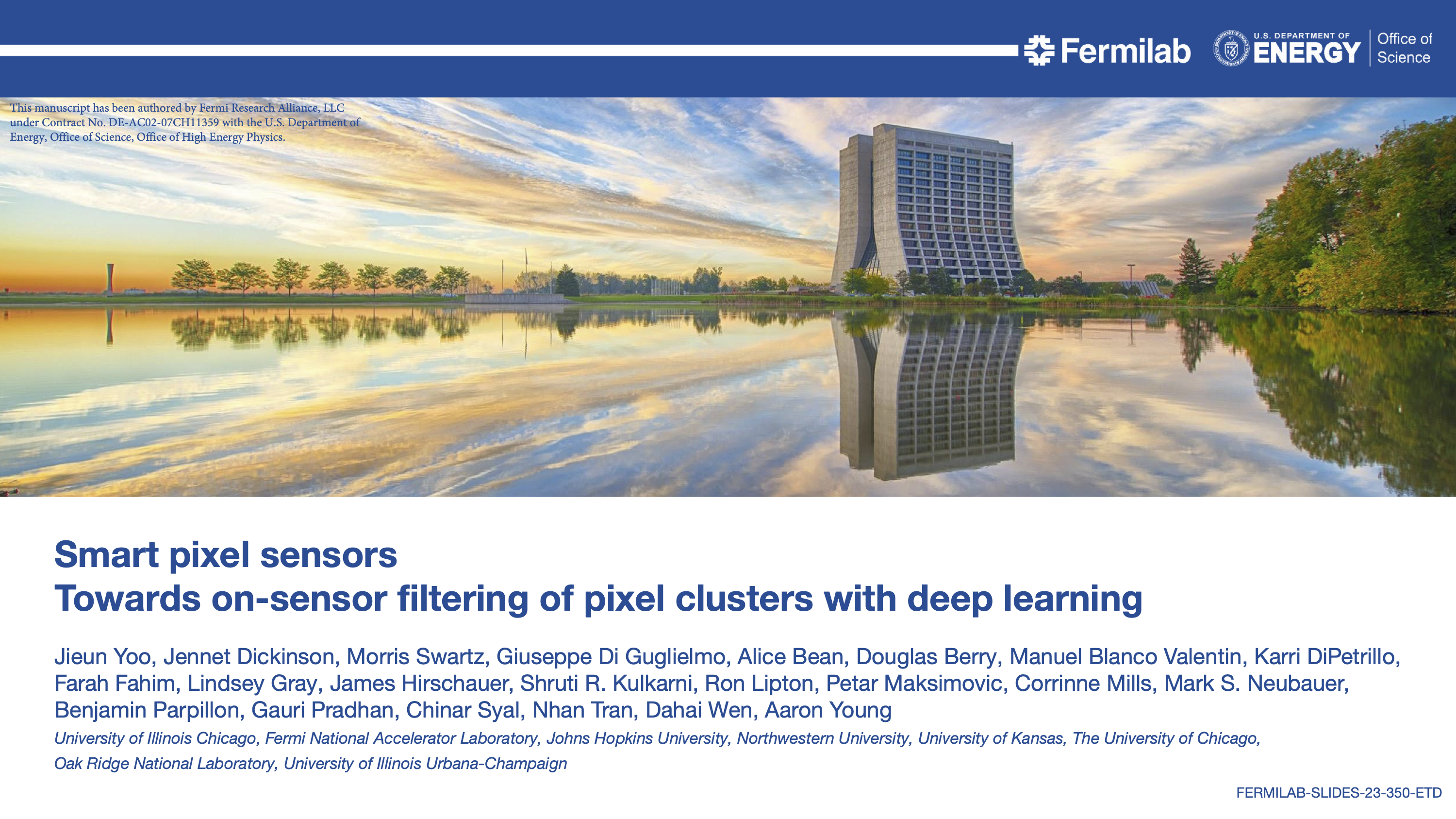 Slides Smart Pixels: Algorithm design and hardware testing for a 28m ROIC for future pixel trackers APS April Meeting Abstracts Smart Pixels: Algorithm design and hardware testing for a 28m ROIC for future pixel trackers. HW Smart Pix. RadHard APS April Publication details Slides
Smart Pixels: Algorithm design and hardware testing for a 28m ROIC for future pixel trackers.
Paper Neural network accelerator for universal quantum control APS March Meeting Abstracts Neural network accelerator for universal quantum control. Quantum NN APS March Publication details Paper
Neural network accelerator for universal quantum control.
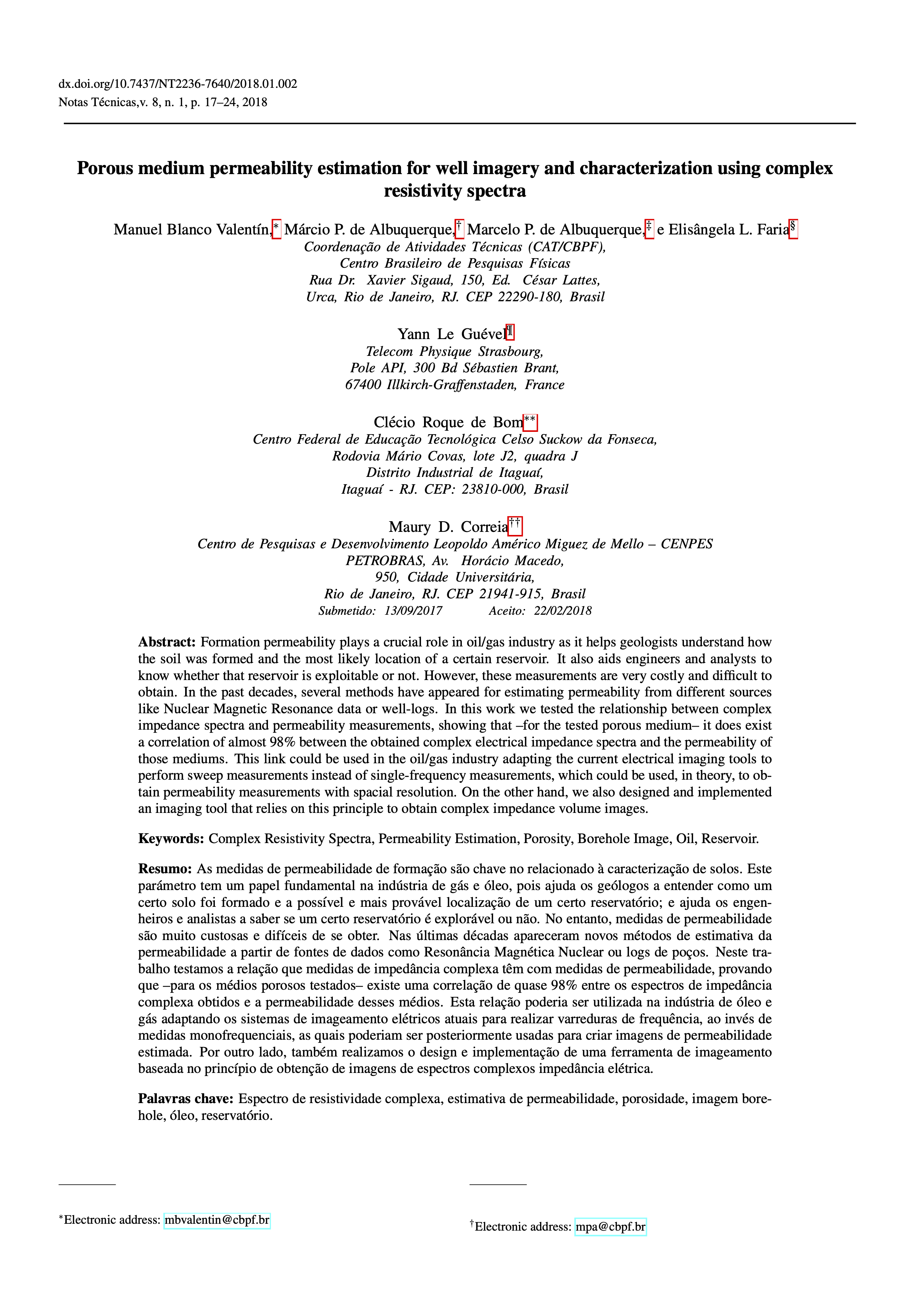 Paper Porous medium permeability estimation for well imagery and characterization using complex resistivity spectra Notas Técnicas CBPF-NT-002/18 fevereiro 2018 Porous medium permeability estimation for well imagery and characterization using complex resistivity spectra. CBPF Publication details Paper
Porous medium permeability estimation for well imagery and characterization using complex resistivity spectra.